History of the 737
Tracing the engineering journey from a preliminary 1964 concept to the definitive twin-engine narrow-body jet airliner.
The Original Requirement
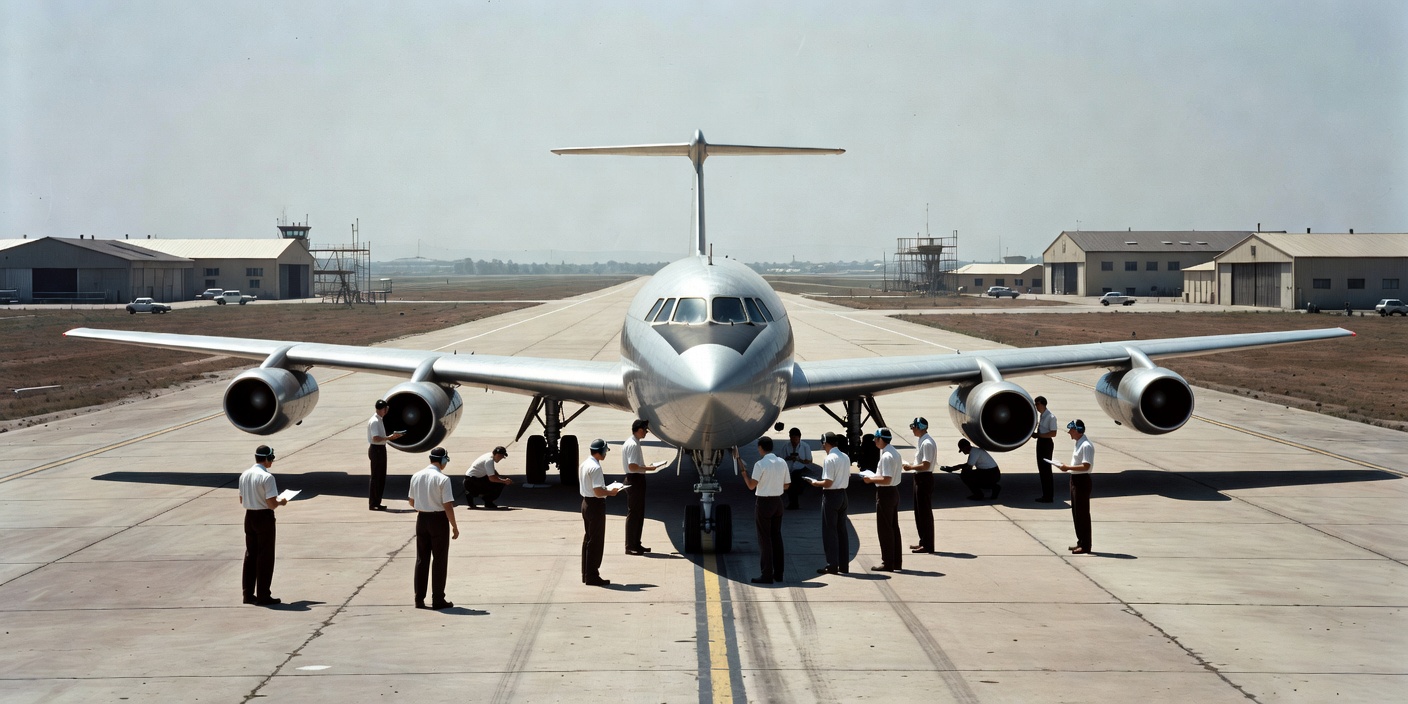
In the early 1960s, Boeing recognized a burgeoning market gap for a short-haul aircraft that could service smaller airports, supplementing the larger 707 and 727 models. Competitors like the BAC One-Eleven and Douglas DC-9 were already in development or entering service. In May 1964, Boeing officially launched a study for a 50- to 60-seat twin-engine aircraft tailored for routes ranging from 100 to 1,000 miles.
The initial designs leaned heavily on contemporary trends, proposing a T-tail empennage and rear-mounted engines. However, engineers quickly realised this configuration presented weight distribution issues and complicated maintenance. Chief engineer Jack Steiner, alongside aerodynamicist Joe Sutter, championed a radical redesign: moving the engines to the wings.
The Wing-Mounted Engine Paradigm
Mounting the engines directly to the underside of the wings yielded profound structural and aerodynamic benefits. It reduced the aircraft's structural weight, as the wing structure bore the load directly, alleviating stress on the rear fuselage. Furthermore, it freed up the rear of the cabin for additional seating and simplified ground maintenance, given that the engines sat much closer to the tarmac.
This layout enabled Boeing to widen the fuselage. By utilizing the same fuselage cross-section as the 707 and 727, the new aircraft could accommodate six-abreast seating rather than the five-abreast layout standard in competing regional jets. This critical decision dramatically improved passenger economics and became a hallmark of the family's success.
Launch and Early Variants
On February 19, 1965, Lufthansa became the launch customer, ordering 21 aircraft for $67 million. This specific variant was designated the 737-100. It was the first and only time a European airline launched a Boeing aircraft. Two months later, United Airlines ordered 40 aircraft, but requested a slightly longer fuselage to accommodate more passengers. This stretched version became the 737-200.
The first 737-100 rolled out on January 17, 1967, and made its maiden flight on April 9, 1967. Following certification, it entered commercial service with Lufthansa in February 1968. The -200 followed shortly after, entering service with United Airlines in April 1968.
Pratt & Whitney JT8D Powerplants
Both the -100 and -200 were powered by Pratt & Whitney JT8D low-bypass turbofan engines. Originally designed for the A-6 Intruder attack aircraft, the JT8D was robust, reliable, and loud. The engines were housed in long, slender nacelles that extended directly under and forward of the wings.
The aircraft was also unique in its lack of main gear doors. When retracted, the main landing gear wheels remained exposed to the airstream in wheel wells beneath the fuselage. Hubcaps on the outer wheels smoothed the aerodynamic profile, a weight-saving and complexity-reducing measure that remains a signature feature across all subsequent generations.
Operational Flexibility and Unpaved Runways
Boeing targeted operational flexibility. To service remote communities in regions like Northern Canada and Alaska, Boeing developed an "Unpaved Strip Kit" (commonly known as a gravel kit) for the 737-200. This kit included a gravel deflector on the nose gear to prevent debris from striking the underbelly, and vortex dissipators protruding from the engine nacelles to prevent foreign object damage (FOD) ingestion.
This adaptability cemented the -200's status as a rugged workhorse. While the -100 saw limited production (only 30 built), the -200 series amassed over 1,000 orders, establishing the foundation for the most successful commercial jet family in aviation history.